
Fair Play is one of the most important criteria when evaluating an online casino. While bonuses, game variety, and design often attract players initially, long-term trust depends on transparency, mathematical fairness, and independent verification. Concepts such as RTP, random number generators, and third-party audits form the foundation of a fair gambling environment.
This article provides a detailed analysis of how Rockstar Casino aligns with recognized Fair Play standards. We examine how RTP works across games, how randomness is ensured, and what role audits play in maintaining player confidence.
What Fair Play means in online gambling
Fair Play refers to a set of principles designed to ensure that casino games operate honestly and without manipulation. In online environments, players cannot physically observe cards being shuffled or wheels spinning, so trust must be established through technology and regulation.
Fair Play standards typically focus on three core pillars:
- transparent mathematical models
- certified random number generation
- independent testing and audits
Together, these elements ensure that outcomes are not predetermined or biased in favor of the operator beyond the known house edge.
Understanding RTP and why it matters
RTP, or Return to Player, represents the theoretical percentage of wagered money that is returned to players over a large number of game rounds. For example, a slot with a 96% RTP will return an average of €96 for every €100 wagered in the long run.
RTP does not guarantee short-term results, but it provides a statistical framework that allows players to compare games objectively. Higher RTP values generally indicate better long-term value for players.
At Rockstar casino https://rockstarcasino.one/, RTP values are defined by game providers and embedded directly into the game software. The casino itself cannot alter these values without invalidating certifications.
RTP consistency across game categories
Different game types offer different RTP ranges due to their underlying mechanics. Slots, table games, and live casino products all follow distinct mathematical models.
Common RTP ranges include:
- video slots: usually between 95% and 97%
- classic table games (RNG-based): often above 97%
- live casino games: dependent on fixed rules and dealer procedures
This variation allows players to choose games that align with their risk tolerance and strategic preferences.
How Random Number Generators work
The Random Number Generator, or RNG, is the core technology behind online casino games. It produces sequences of numbers that determine game outcomes, such as reel positions in slots or card distribution in digital table games.
A proper RNG must meet several criteria:
- unpredictability
- uniform distribution
- non-repeatability
- independence from previous results
Certified RNG systems use complex algorithms that generate millions of numbers per second, ensuring that outcomes cannot be predicted or influenced.
RNG certification and validation
RNGs are not trusted solely based on claims by the casino or provider. They must be tested and certified by independent testing laboratories. These organizations analyze the algorithm’s behavior over massive data sets to confirm statistical randomness.
Once certified, the RNG software is locked. Any modification would invalidate the certification and trigger compliance issues with regulators or auditors.
Difference between RNG games and live games
While RNG governs digital games, live casino products operate differently. Live games use physical equipment—cards, wheels, and dice—handled by trained dealers. In this case, fairness is ensured through procedural controls rather than algorithms.
Live casino fairness relies on:
- continuous video streaming
- standardized dealer procedures
- visible physical outcomes
- real-time monitoring
Although RNG is not involved in the outcome generation, live games are still subject to audits to verify operational integrity.
Role of independent audits
Audits are a critical component of Fair Play. Independent auditors examine both software and operational processes to ensure compliance with fairness standards. These audits are typically conducted on a recurring basis rather than as a one-time check.
Audit processes may include:
- RTP verification over large samples
- RNG behavior analysis
- system security checks
- compliance with published rules
The goal is to confirm that the casino operates exactly as advertised.
Frequency and scope of audits
Audits are usually performed at regular intervals, such as quarterly or annually, depending on regulatory requirements and internal policies. Some audits focus exclusively on game fairness, while others assess financial integrity and data protection.
This layered approach ensures that fairness is not only theoretical but continuously enforced.
Transparency toward players
One of the indicators of Fair Play is how openly a casino communicates information to players. Clear access to game rules, RTP values, and bonus conditions reduces ambiguity and builds trust.
Players benefit when they can:
- view RTP information directly in games
- access terms and conditions without restrictions
- track game history and session data
Transparency does not eliminate risk, but it ensures informed decision-making.
RTP vs volatility: common misconceptions
Many players confuse RTP with volatility. While RTP reflects long-term return, volatility determines how wins are distributed over time. A high-RTP game can still produce long losing streaks if volatility is high.
Understanding this distinction helps players avoid false expectations and evaluate games more realistically.
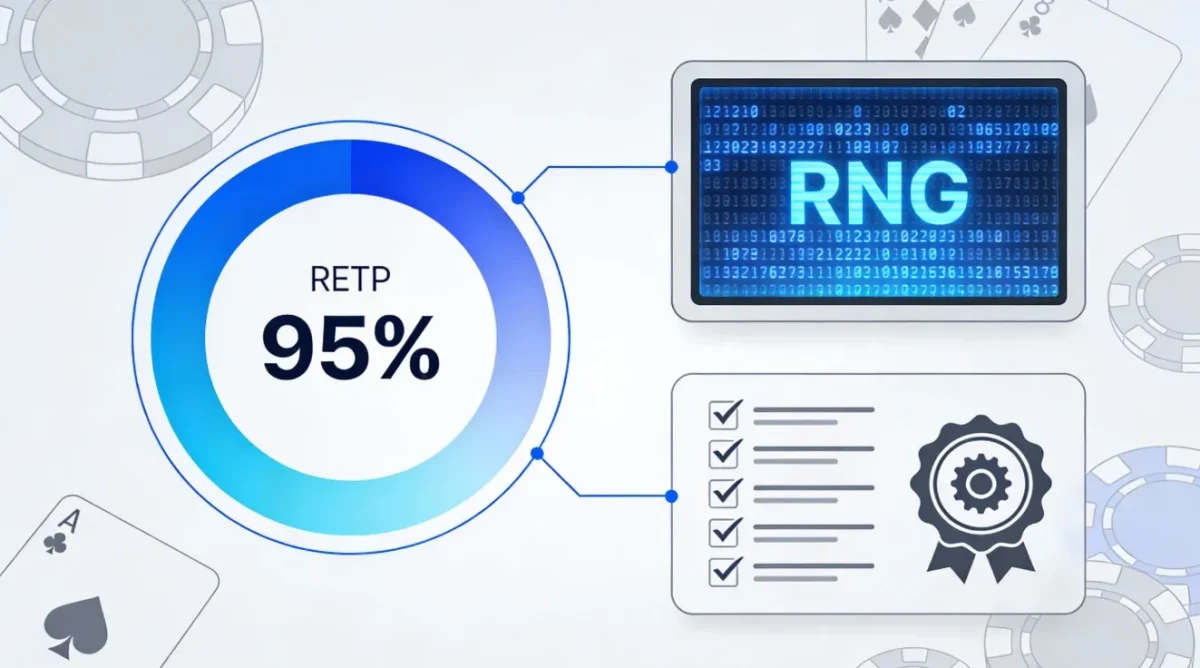
Fair Play elements and their function
The table below summarizes the key Fair Play components and their role in online casino integrity:
| Component | Purpose | Player benefit |
|---|---|---|
| RTP | Defines long-term return | Informed game selection |
| RNG | Ensures randomness | Unbiased outcomes |
| Audits | Verifies compliance | Increased trust |
| Transparency | Clear information | Reduced misunderstandings |
This framework shows how different elements work together rather than in isolation.
Limitations of Fair Play guarantees
While Fair Play standards ensure mathematical and procedural fairness, they do not guarantee profits. All casino games include a house edge, and short-term variance can lead to losses even in high-RTP games.
Fair Play ensures that losses occur within expected statistical boundaries, not through manipulation.
Player responsibility within Fair Play systems
Fair Play protects players from unfair practices, but responsible usage remains essential. Understanding RTP, volatility, and bonus terms allows players to engage more consciously and avoid unrealistic expectations.
Fairness does not replace the need for bankroll management and informed decision-making.
Continuous improvement and monitoring
Fair Play standards evolve alongside technology. New game formats, features, and platforms require updated testing methods and compliance frameworks. Ongoing audits and system updates help maintain alignment with modern standards.
This adaptability is essential in a rapidly changing digital gambling environment.
Conclusion
Rockstar Casino’s alignment with Fair Play standards is built on three core elements: transparent RTP values, certified random number generation, and independent audits. These components work together to ensure that games operate according to published rules and mathematical models.
While Fair Play does not eliminate risk or guarantee winnings, it provides a foundation of trust that allows players to engage with confidence. Understanding how RTP, RNG, and audits function empowers players to evaluate games objectively and make informed choices within a regulated and transparent environment.